


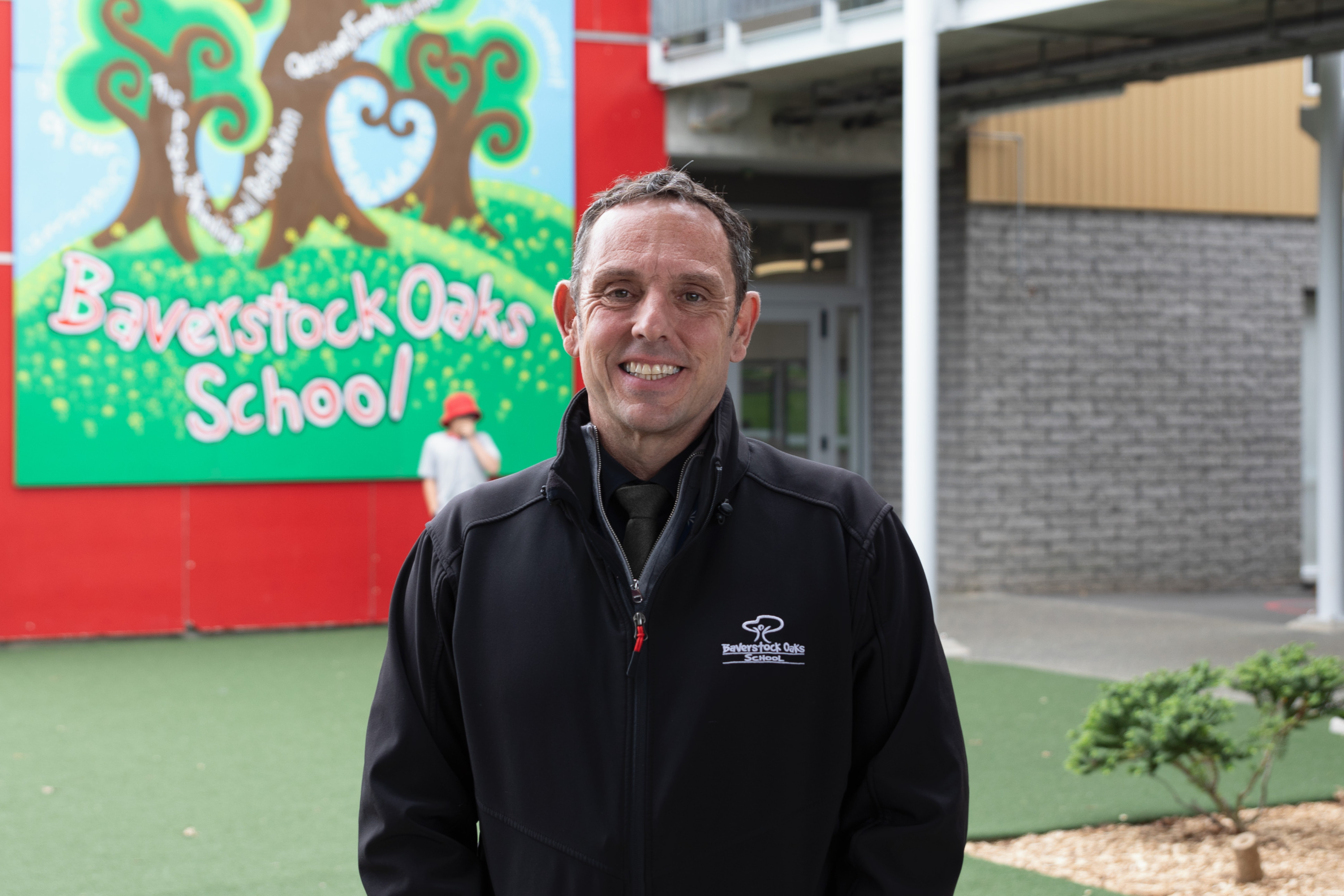
Ian Dickinson taught at Baverstock Oaks when Flat Bush was building sites. He is back as principal.
When Ian Dickinson taught in Room 6 at Baverstock Oaks School, the view out the window was a few building sites and not much else.
That was January 2007.
He is back, nearly 20 years on, as the school’s third principal, and the building sites are now the suburb that fills its classrooms.
The whole area, he said, has just exploded.
He is two months in and enjoying himself to a degree he is happy to admit.
“Being principal of a school is the best job in the world,” Dickinson said.
“So when you’re the principal of a school in an amazing school like this, it’s just the icing on the cake.”
He got here the first time almost by accident.
Teaching in Yorkshire, in the north of England, he flew 13,000 miles to look for a job, was told he was not on the shortage list and went home without one.
What he did have was a meeting with Baverstock Oaks’ founding principal Mary Wilson, who was in Britain on secondment.
A phone call came that October with a job offer he had not known he was in the running for.
“Mary went into bat with the ministry and said, this guy has a skill set that we need,” Dickinson said.
The family had two months to decide.
“Do we go? Do we sell our house? Do we take the risk?”
They went.
Dickinson stayed about 18 months before moving to an intermediate school nearby as a deputy principal.
He then spent nine years as principal of Pigeon Mountain Primary, which is where the job stopped feeling like one.
“I’m a guy who’s never done a day’s work in his life,” he said.
“I love schools, being involved in students and working with staff.”
By the early 2020s his own children were leaving home and his wife, also a teacher, was in the same position.
A former colleague who had taken a job in Saudi Arabia told him he would like it there.
The couple decided they were due a second OE, 20 years after the first one brought them here.
In April 2024 they flew to Riyadh, and then three hours out of it, to open a British international school on a Saudi air force base.
The place was a building site with a September deadline.
“Everything was brand new build,” he said.
“New compound, new housing, new pools, new works.”
It opened with about 60 children, the sons and daughters of pilots recruited by BAE Systems to teach Saudi cadets to fly.
“About between eight and ten children per class, which is a dream,” Dickinson said.
Getting anywhere took a while.
He said it was 25 minutes just to get off the base, through armed guards, in and out, and another 25 minutes down into town.
The job, as he described it, was to build a school culture from nothing and then make it feel like any other school.
“Make sure that within the middle of the desert, in the middle of an air force base, in this isolation, children had a lovely, happy education,” he said.
It worked.
It also changed what he thought about the schools he had left behind, where teachers do the same work with three times the class size and less to do it with.
“Twenty-eight, 29, 30, 31 children, less resources, but just magnificent at getting on with things,” Dickinson said.
He came back, he said, “with a newfound appreciation for New Zealand”.
He also came back to a school that has spent two decades being caught up with.
Baverstock Oaks opened in 2005.
The roll has been as high as 700 and Dickinson puts it at about 615 now.
He said he could only hypothesise as to why, and pointed at fewer school-aged children on this side of Auckland and at new schools opening nearby and spreading them around.
There is room to grow back, he said.
What has not changed, in his reading of the place, is what the school is to the streets around it.
“It’s not a school that’s grown within a mature community,” he told the Howick & Eastern Post.
“It’s a school that’s been there and the community’s grown around it, so it becomes the anchor.”
The buildings have held up better than the years would suggest, and he said the place does not feel 20 years old.
He started mid-year, which he now thinks was lucky.
There was no strategic plan waiting to be formulated and no start-of-year systems to bed in.
“Coming in mid-year, I’ve been able to just be present and just focus on forming relationships, whether it be students, whether it be with staff, whether it be community,” Dickinson said.
He was, when he spoke to this newspaper, on day 36.
“I’m kind of still counting the days, but in a happy sense,” he said.
Most of those days have had a cultural celebration in them, and he intends to keep that running for the rest of the term.
Baverstock Oaks is one of the more mixed school communities in Auckland.
Dickinson said the largest group of pupils are Indian, with Chinese, Maori and Tongan families behind them.
He called the school a very modern microcosm of modern New Zealand, then stopped to look for a better word and could not find one.
What binds the place together, he said, is Te Ao Māori.
“It’s the glue that holds us all together.”
He does not accept that any of this makes the job harder.
“Every child coming to school can be proud of who they are and is not having to hang an aspect of themselves up at the gate to come into school to conform,” he said.
“When a child feels they identify and they belong here, then they’re switched on,” he said.
“So actually it helps us.”
Asked what he intends to change, he was blunt about the limits of the question.
Wilson set the school’s values.
Genee Crowley, who took over when Wilson retired in 2018, kept them.
“Perhaps mine is the third act,” Dickinson said.
“There’s no point in changing something just for the sake of changing it.”
Changes will be made where they are needed, he said, and the school already has good outcomes and children who want to come to it.
The one shift he named is attendance, which he said has become a striking new emphasis in New Zealand schools in the time he was away.
The other thing he brought home is an interest in what technology can take off teachers.
“Teachers’ jobs just get harder and harder,” he said.
Tools that cut their workload, in his view, free them to spend their effort in the classroom.
Twenty years in New Zealand schools has also left him with a working assumption about policy, in an election year in which education is again being argued over.
“The only thing that’s certain is that there’s going to be change,” Dickinson said.
“There’s no sense in railing against things, because they are what they are.”
The better development, in his view, is that decisions are now more often made on evidence, “rather than just taking a shot in the dark at the next fad that comes along”.
Day to day, he said, the school does not need him.
Three assistant principals run it, and he put the arrangement as a ship.
“If Baverstock is a tanker, they’re on the bridge,” he said.
“And I’m in the helicopter flying above, and we’re seeking new destinations, looking out for dangers, working with the board to ensure that strategically we’re heading in the right direction.”
In five years he wants graduates who leave carrying the school’s values, and teachers who want to work there to continue their own development, and grounds with enough in them that every child has a reason to turn up.
“What’s their thing?” he said.
“For some children it might be beyond what’s in the classroom.”
“They may love the sandpit. They may love the playground. They may love the track.”
For now he is walking corridors he last walked as a young teacher from the UK.
“You’ve got that muscle memory.”
“You do feel like you’re walking through, except I’m twenty years older than I used to be.”

