


A woman had her handbag stolen and was assaulted in the Kmart Botany carpark on Friday afternoon, and within hours local Facebook groups had moved from sympathy to strong feelings about local crime rates.
By Saturday morning a single post in the East Auckland Grapevine had drawn more than 200 reactions and 70 comments.
East Auckland residents were vocal about crime rates, with a selection of their comments published here, with the commenters not identified for their privacy.
“Sad to hear, hope she is ok,” wrote one commenter, before asking what was happening to East Auckland.
Another wrote that her family had moved “to NZ for safety etc but now it becoming worse than from where we came from.”
A third wanted a description of whoever was responsible, and asked whether anyone had seen anything.
For this publication’s first story on the attack Amber Robinson-Frani provided eye witness comments.
She too shared the sentiments expressed by locals, calling on people to “stay safe out there people, its getting rough,” as well as suggesting to people that the assault served as “a reminder to always watch your back, lock your car as soon as you enter it.”
Following the story about the assault and readers’ reactions, the Howick & Eastern Post investigated the issue.
So are they right?
The official answer is that the fear is real, the memory is accurate, and the crime figures partly back them up.
Police figures tell a mixed story.
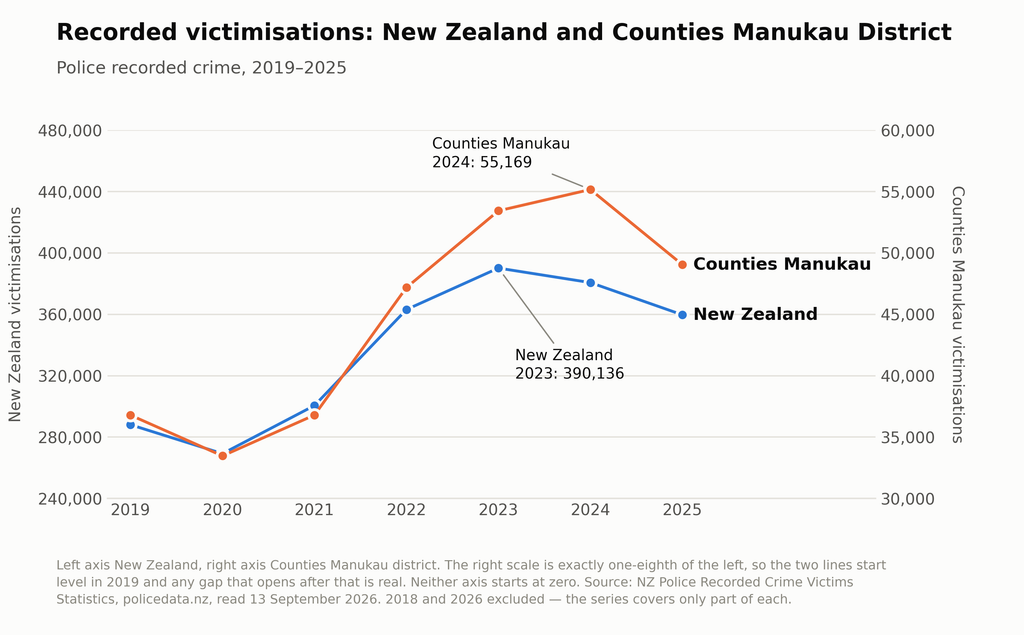
Nationally, Police recorded 359,678 victimisations last year.
That is down 8 per cent from the 2023 peak of 390,136, and 25 per cent above 2019.
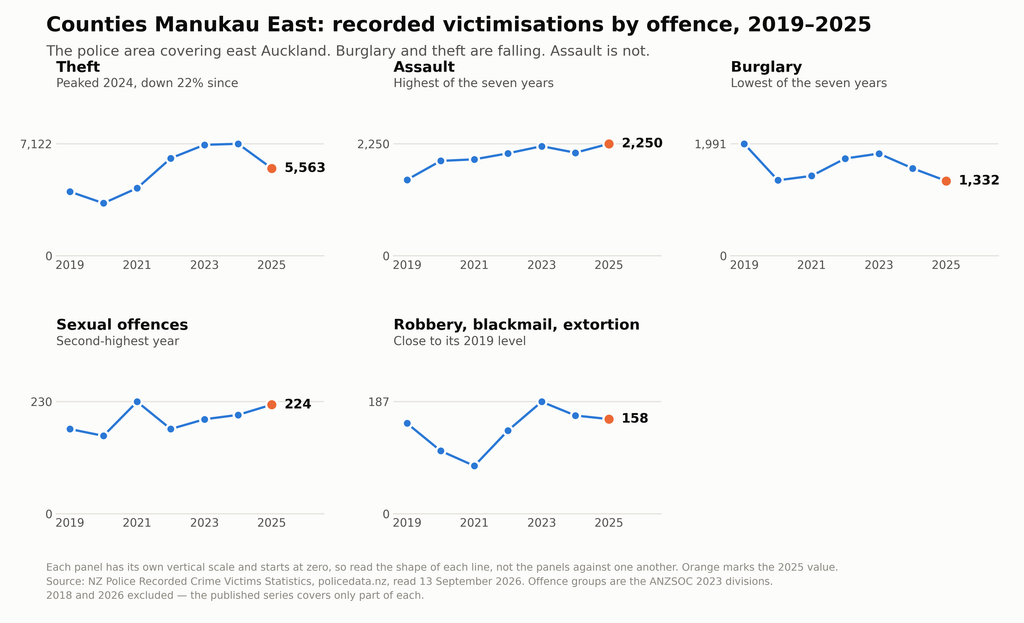
Burglary fell over the same period, down 15 per cent on 2019.
Assault went the other way.
There were 78,290 assault victimisations recorded across New Zealand last year, the highest in the published series and 43 per cent more than in 2019.
The pattern in east Auckland is much the same.
Counties Manukau East — the police area covering Howick, Botany, Pakuranga and Flat Bush — recorded 9537 victimisations last year.
That is down 17 per cent from the 2023 peak of 11,468, and still 20 per cent above 2019.
Burglary is the clearest improvement, down to 1332 last year from 1991 in 2019, the lowest of the seven years police have published.
Theft peaked in 2024 and fell 22 per cent last year.
Assault did neither.
There were 2250 assault victimisations recorded in Counties Manukau East last year, the highest in the published series and 47 per cent more than in 2019.
It rose in a year when almost everything else fell.
Recorded crime is only half the measure.
The Ministry of Justice’s annual survey, which asks about 8000 New Zealanders what has actually happened to them, found that only about a quarter of all crime was reported to Police last year.
The same survey found 12 per cent of adults felt unsafe because of crime.
In 2018 it was 9 per cent.
The proportion who said they felt completely safe has gone the other way, from 30 per cent to 25.
Fear peaked in 2023 and has eased a little each year since, but it has not returned to where it was.
Aucklanders feel it more sharply than most.
In Auckland Council’s most recent Quality of Life survey, 79 per cent of respondents called crime a problem in their city or local area — the highest-ranked of every issue put to them.
Among Aucklanders who thought their area had become a worse place to live, 49 per cent blamed crime.
The national survey also found something that explains a Facebook thread better than any of it.
More than three-quarters of adults said they were worried about crime nationally.
Fewer than half were worried about crime in their own neighbourhood.
Ministry of Justice general manager of sector insights Rebecca Parish said feelings of safety were driven by more than experience.
“That can be influenced by a lot of things, if they’ve experienced things themselves as victims or also media reporting of crime can play a role in people’s sense of safety.”
On the survey’s own measure, fewer New Zealanders are being victimised than at any point since it began.
Twenty-eight per cent of adults were victims of crime in the year to October 2025, down from 30 per cent in 2018.
Politicians have their views.
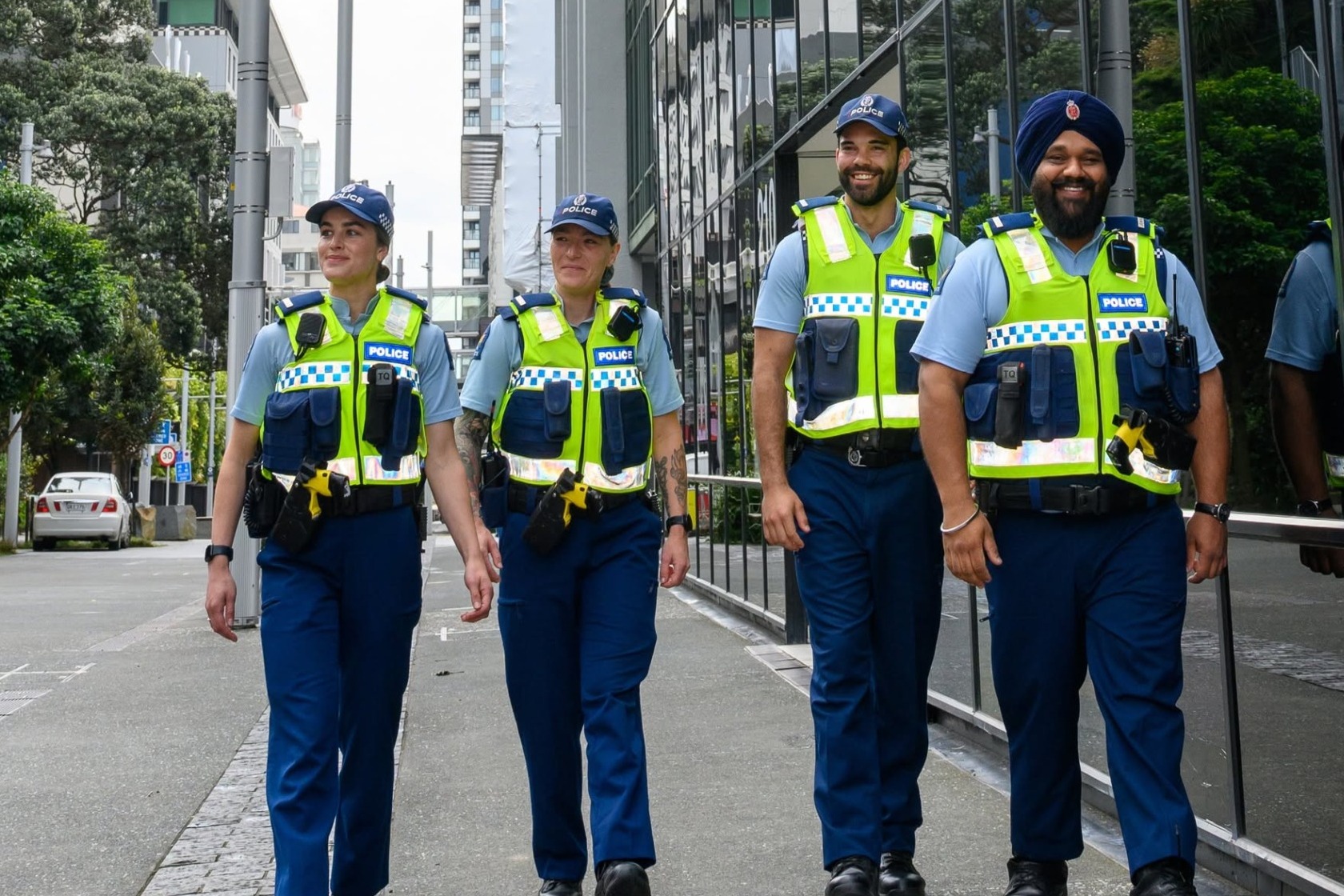
Police Minister Mark Mitchell puts the national improvement down to visibility.
“A higher visibility of Police in our communities goes a long way to deterring crime and keeping criminals off our streets,” he said in February.
“It is no coincidence that our back-to-basics approach to policing is having a positive effect on reducing violent crime.”
Foot patrols have close to doubled since late 2023 and 12 beat teams have been stood up around the country, though none is based in east Auckland.
The Government has restored Three Strikes, capped sentence discounts at 40 per cent, and passed the Gangs Act, under which police seized 182 patches and 178 firearms in its first year.
In August it widened citizens’ arrest powers and raised penalties for retail crime.
Justice Minister Paul Goldsmith said in February there were 136,000 victims of violent crime in the year to October 2025, 49,000 fewer than two years earlier.
The coalition’s other law and order promise has not gone as smoothly.
National and New Zealand First agreed in 2023 to train no fewer than 500 new frontline police within two years, a deadline that passed last November with the target unmet.
As at 20 April this year there were 297 more constables than when the Government took office.
Treasury projected the full 500 would not be reached until this month, almost a year late.
Labour’s police spokesperson Ginny Andersen said the promise had been made and broken.
“If New Zealanders have been told that they’re going to have 500 more police in place by the 27th of November, then there is a clear expectation that the government should deliver on that promise, and they’ve failed to do that.”
“The failure to deliver those extra police officers just puts more pressure on an already stretched front line.”
Associate Police Minister Casey Costello, who holds responsibility for the target, said in April the money had been provided and the officers were coming.
“Our numbers are on track, and with usual attrition rates, the extra 500 will be delivered this year.”
The Greens question the premise that more police on the street is what makes people feel safe.
The party’s police spokesperson, Tamatha Paul, said last year that beat patrols in her Wellington Central electorate had the opposite effect on some residents.
“For a lot of people, it makes them feel less safe.”
“It’s that constant visual presence that tells you that you might not be safe there, if there’s heaps of cops.”
Trust and confidence from East Aucklanders
Back in East Auckland, locals expressed support for Police’s swift efforts over the Kmart Botany attack.
“Well done to the Police,” wrote one community member commenting on the issue on Facebook.
“Excellent work by our awesome Police,” wrote a second.
As word spread that a 39-year-old Ōtara man had been arrested and charged, the conversation turned from the carpark to the courts.
“Let’s hope the courts follow through,” wrote a hopeful resident.
Her comment drew 30 reactions, more than any other comment on the thread.
“dont hold your breath,” replied someone.
That scepticism is measurable, and it is not confined to east Auckland.
The same national survey that tracks how safe people feel also asks how far they trust the system that deals with offenders.
It found that while 81 per cent of adults had at least some trust in the justice system, only 44 per cent had high trust in it.
Among Māori adults the figure was 28 per cent.
Among Asian adults it was 59 per cent.
Trust in Police held steadier at 69 per cent, and 74 per cent of New Zealanders agreed Police dealt effectively with serious crime, up from 70 per cent a year earlier.
Assistant Commissioner Jeanette Park said in March the figures were down to frontline staff.
“Maintaining trust and confidence within our communities is a constant priority for New Zealand Police.”
“While these results are encouraging, there is always more work to do.”
The 39-year-old man was due to appear in the Manukau District Court.

