


Charges of up to $7 were modelled and about $5 will go to the public, with engagement opening in November
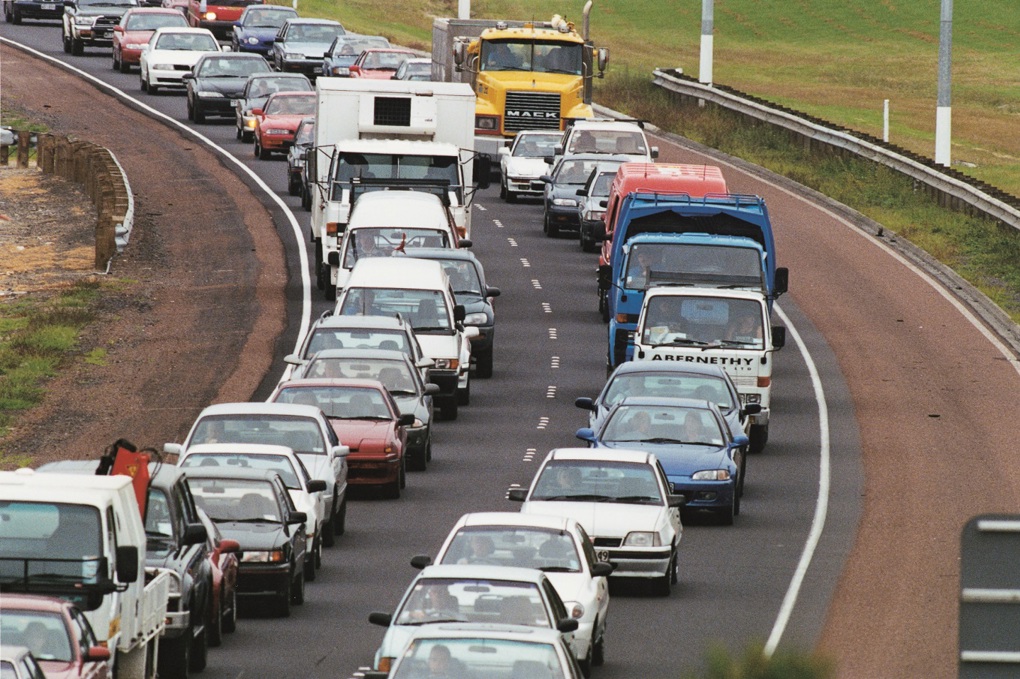
Auckland drivers could pay to use the city’s core motorways at peak times under three options Auckland Council will put to the public in November, and one of them reaches as far east as Mt Wellington.
The Council says time of use charging is being explored as a method that could help ease Auckland’s traffic challenges.
It is a type of congestion charging, but drivers only pay a fee when travelling on the roads at specific times.
The Council says it gives road users the option to change when they travel, take a different route, or switch to public transport to avoid paying the fee.
The money collected would fund transport upgrades and improvements, including public transport, and the law requires it to be spent in the region that paid it.
One of the options under consideration would charge the core motorway network indicatively between the Harbour Bridge, Point Chevalier and Mt Wellington, which would catch drivers heading into town from Howick, Pakuranga and Botany.
This approach has a supporter in Howick Ward councillor Maurice Williamson.
“I’m in favour of time of use charging, always have been,” he told the Transport and Infrastructure Delivery Committee on 25 August.
“Actually I think if you’ve got a limited supply of a product and you’ve got a huge demand of people wanting it, that one of the things you can use is pricing signals to try to filter the usage of that product.”
“I’m really a big fan of the number 3 option and the whole motorway thing,” he said.
“I think doing little weak cordons around the city centre makes no sense whatsoever.”
He did raise a local problem.
“As a ward councillor way out east, we don’t have a train system,” he said.
“When we did all the walkable catchment stuff in Plan Change 120, huge chunks of our suburbs were outside of even a walkable catchment to a bus.”
“And so everyone will say to me, you tell me I can catch public transport, how do I do it from here?”
The Council’s explainer, published ahead of the consultation, says charges of $2 to $7 were modelled, and that about $5 is the highest figure it will take to the public.
Drivers who pay could save up to 12 minutes at peak.
Five per cent of vehicle trips would be charged under each of the two city centre options and seven per cent under 3C.
The Council says up to 31 per cent of drivers would get more reliable travel times, most of them without paying anything.
The three areas were chosen because they are the ones best served by public transport.
The City Rail Link, which opens on 13 September, will double the number of people who can reach the city centre by public transport within half an hour.
Mayor Wayne Brown, who has pushed the charges for three years, says the case is the economy.
“Traffic congestion is costing Auckland’s economy around $2.6 billion every year,” he said in a statement the day of the decision.
“It’s hurting productivity, impacting businesses and wasting people’s time.”
He asked officers whether it was true that every city that had actually brought a charge in had made it work, and that the failures were the cities that lost their nerve and never went ahead.
Hamish Bunn, the Council’s time of use charging project lead, told the committee the overseas record answered that.
“All the cities where it’s been implemented, you’ve had the significant congestion reductions,” he said.
“Generally speaking the public support for the schemes has increased after implementation,” he said.
He said the benefits would reach drivers who never paid the charge.
“Aucklanders outside of the charged area are still, generally speaking, likely to get some kind of benefit,” he said.
Brown then argued the real gain was not the money collected but the roads the city would not have to build.
“If you don’t get any improvements, the next thing people ask for is more bloody roads,” he said.
Not everyone at the council table was convinced.
Councillor John Gillon said the scheme was “essentially a tax on getting to and from work”, and that at $2 to $7 a trip it came to “up to $70 charge per week”.
He singled out the option Williamson wants.
“I’m particularly concerned about option 3C that includes charges to use parts of the Northern Motorway, Southern Motorway and Northwestern Motorway,” he said.
“This will capture anyone travelling past the city to get to work.”
Councillor John Watson said many drivers would simply pay because they had no alternative.
“Even that goes to people who can’t really afford to be paying an extra $50 a week or whatever it is,” he said.
The Council does not have the last word.
Under the Land Transport Management (Time of Use Charging) Amendment Act 2025, every scheme needs the Government’s approval, and Transport Minister Chris Bishop has already folded the charges into his plans for the network.
Releasing the Auckland Motorway Strategic Plan on 20 August, he listed time of use charging among the tools for getting more from roads that in many places cannot be widened further.
Public engagement opens in mid-November, the same week the Act comes into force.
The Council is expected to decide on a preferred area in March next year.

