


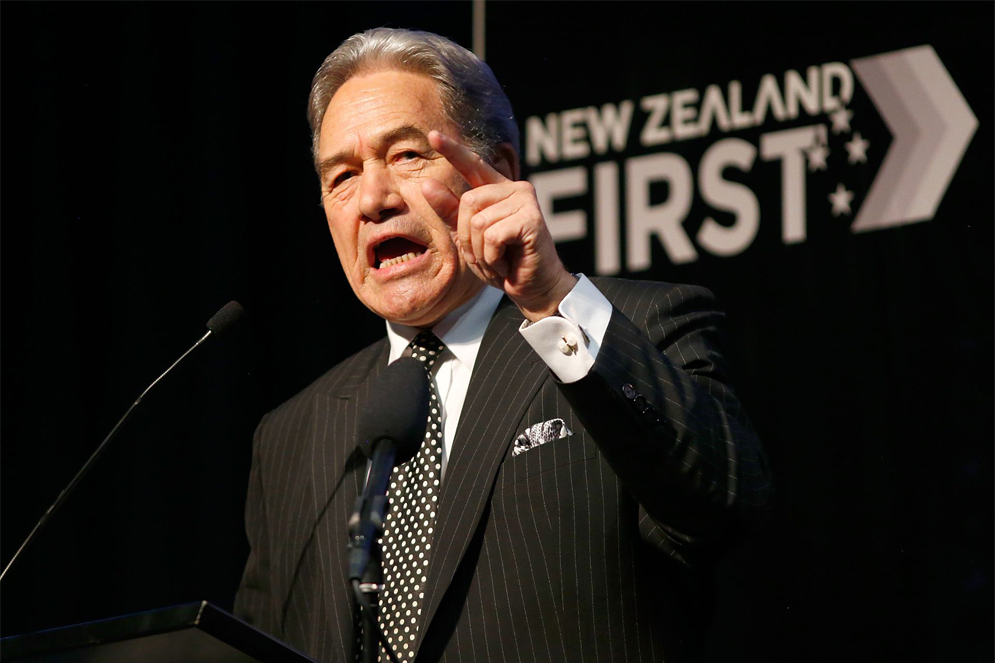
New Zealand First will campaign on abolishing Auckland Council’s Maori advisory board, a move the mayor calls “dumb, racist stuff”
New Zealand First will campaign at this year’s election on abolishing Auckland Council’s Independent Maori Statutory Board.
Party leader Winston Peters announced the policy on 18 June, saying a member’s bill had been drafted.
The bill is in the name of New Zealand First MP Dr David Wilson and, if it were passed, would transfer the board’s functions, property and obligations back to Auckland Council.
The board, known as Houkura, was established through the Local Government (Auckland Council) Act 2009 and began work in 2010 alongside the Auckland Super City.
It has nine members, appointed through a statutory process in which a selection body of Auckland iwi representatives is convened every three years by the Minister for Maori Development.
The board can appoint up to two members to Council committees dealing with natural and physical resources, where those appointees hold voting rights.
Peters said the amalgamation of Auckland’s councils was meant to deliver stronger representation and lower costs.
“Instead, it has produced a large and increasingly remote bureaucracy in which key decisions are shaped by unelected officials, parallel governance structures, and statutory bodies that are not accountable to ratepayers,” Peters said.
He said the board was set up to give advice but had spread well past that.
“Although originally established to provide advice, its statutory documents and appointments have become embedded across council planning, funding, procurement, and performance systems,” Peters said.
“Aucklanders were never asked whether they agreed to fund or empower a parallel governance system within their council.”
Peters said ratepayers paid $3.5 million towards the board’s operations last year “despite having no ability to elect or remove its members”.
He said that had contributed to a democratic deficit at a time when Aucklanders faced rising rates, increasing debt and reductions in core services.
Peters said removing the board would not stop the Council engaging with Maori.
“It does not prevent Auckland Council from engaging with Māori or recognising their interests, rather it ensures that such engagement occurs within democratically accountable structures,” he said.
Mayor Wayne Brown rejected the proposal in a statement to RNZ on 19 June.
“It’s just dumb, racist stuff we don’t need at a time when people are struggling to put food on the table and pay bills,” Brown said.
“What’s the problem they’re trying to solve?”
Brown said the Council already had several committees and advisory forums that enabled discussion and a range of views.
“My suggestion to Wellington is butt out of our business,” he said.
“Auckland is quite capable of making decisions that work best for us.”
Houkura chair David Taipari defended the board in an opinion piece sent to RNZ on 26 June, saying scrutiny of its purpose and funding was nothing new.
“They tend to emerge whenever the political climate shifts,” Taipari said.
“That’s happening again now, and while criticism comes with the territory, some recent commentary has painted a picture that doesn’t reflect how Houkura actually works.”
He said calling the board an unelected parallel government did not describe how its members were appointed or what they did.
“Every three years, a selection body comprising representatives of Auckland iwi is convened by the Minister for Māori Development,” Taipari said.
He said the board had no decision-making authority over the Council and held voting rights only at committee level.
“We do not have a vote on Auckland Council’s governing body, where all final decisions are made,” he said.
“We do not set rates and we do not run the council.”
Taipari said the board’s $3.5 million operating budget worked out at roughly $2 per Aucklander, and that a larger figure was sometimes cited in public debate.
ACT is pursuing the same issue by a different route.
ACT MP Cameron Luxton told RNZ the Local Government (System Improvements) Bill already before Parliament could be amended to remove voting rights from the board’s appointees.
“If the Minister’s upcoming amendments don’t cover the IMSB, I will introduce an amendment that does,” Luxton said.
“ACT is already working within the Coalition to solve this problem right now.”
He said the party did not have to wait for “something New Zealand First may or may not do at some point in the next Parliamentary term”.
The general election is on Saturday 7 November.

