


Booths return in 2028 after fraud in Papatoetoe, and councillors are still arguing over the bill
While the country spent the past few months focused on the general election, New Zealand’s biggest city was quietly working out how to change the way it votes.
On 29 September Auckland Council’s Governing Body voted 13 to three to drop postal voting and bring back the voting booth for the 2028 local elections. The council says it is the first time since 1992 that any council in New Zealand has chosen booths.
Auckland councillors are considering the topic again this month, with initial costings prepared for a Governing Body workshop showing the move could cost up to $27.6 million.
So why is Auckland doing it?
The council’s answer is trust. Its general manager of governance and engagement, Lou-Ann Ballantyne, said in a statement that booth voting “was identified as the strongest option for supporting electoral integrity and public confidence”.
Behind that trust question are a string of recent electoral challenges, notably a voided election in Papatoetoe, allegations of stolen voting papers in Manurewa, and a postal service in decline.
What happened in Papatoetoe
Vi Hausia went into the 2025 local elections as deputy chair of the Otara-Papatoetoe Local Board. When the results came out, he had finished fifth in Papatoetoe and lost his seat.
“Last year, when the results were released, I knew something was not right,” he told the Howick & Eastern Post. “In elections, you win or you lose, but being cheated is something that should never happen.”
“It was not just that I was being cheated; the people whom we were vying to represent were also being cheated.”
All four Papatoetoe seats had gone to first-time candidates from the Papatoetoe-Otara Action Team, each by more than 1,000 votes. Turnout in Papatoetoe went up while it fell almost everywhere else in Auckland, and residents began complaining that their voting papers had been taken from their letterboxes.
Hausia, who had stood for Labour, took the electoral officer to the Manukau District Court.
In December Judge Richard McIlraith declared the election void, and the High Court upheld his ruling in March. The court heard that 79 votes had been cast irregularly, and the judge found fraud had “permeated or infected” the result, with its true extent likely “much greater” than anyone knew.
At the re-run in April, Hausia won his seat back and Action Team members took the other three. No one has been prosecuted.

In his thank-you post to Papatoetoe voters after the re-run, Hausia went further. “Whilst the battle has been won, the war to strengthen our democracy is not over,” he wrote.
“I am calling on Auckland Council and elected members at both local and central government level to end the postal ballot voting system.”
He said he trusted the council’s decision would bring Papatoetoe “some closure to what has been a turbulent time”.
Why postal voting took over
Graeme Edgeler, a barrister with a special interest in electoral law, said councils have always been free to run booths. “Most councils have used postal voting, but they have always had the option of booth voting,” he told the Howick & Eastern Post.
Edgeler said the shift came around the 1989 local elections, after the Local Government Commission recommended councils try the post. Booths fell out of favour for two reasons.
“It is more expensive. And at least historically, turnout was much lower,” he said.
“When we moved to postal voting, there was a bump up in turnout.”
That ease is still what brings many people to vote, in his view. “A lot of people vote in local elections because it’s relatively easy,” he said.
“Once you’re enrolled, particularly if you haven’t changed your address in a while, you just get sent the voting form and it’s a relatively easy thing to do at some point to send it back.”
Voting at home also carried risks. Edgeler listed “taking other people’s voting papers”, “voting on behalf of your partner” and “pressuring someone how to vote”.
“Those have always been risks with voting which takes place in the home,” he said. “The secrecy of the ballot is a lot harder if you’re not in a box where you’re the only person there.”
Low turnout makes those risks harder to spot. “One of the reasons it can happen is that a lot of people don’t vote in local elections,” Edgeler said.
At a general election, where 75 to 80 per cent of people vote, “you’d notice very quickly if a whole bunch of people were voting twice”, he said. In a local election, “a lot of people just won’t miss their voting papers”.
The post itself is also fading from people’s lives. For some younger voters, Edgeler said, a voting paper may be the only letter they send every three years.
“It may be that postal voting is dying because of that,” he said.
The photographs from Manurewa
Earlier this year, following the Papatoetoe by-election, more allegations of irregularities emerged from Manurewa.
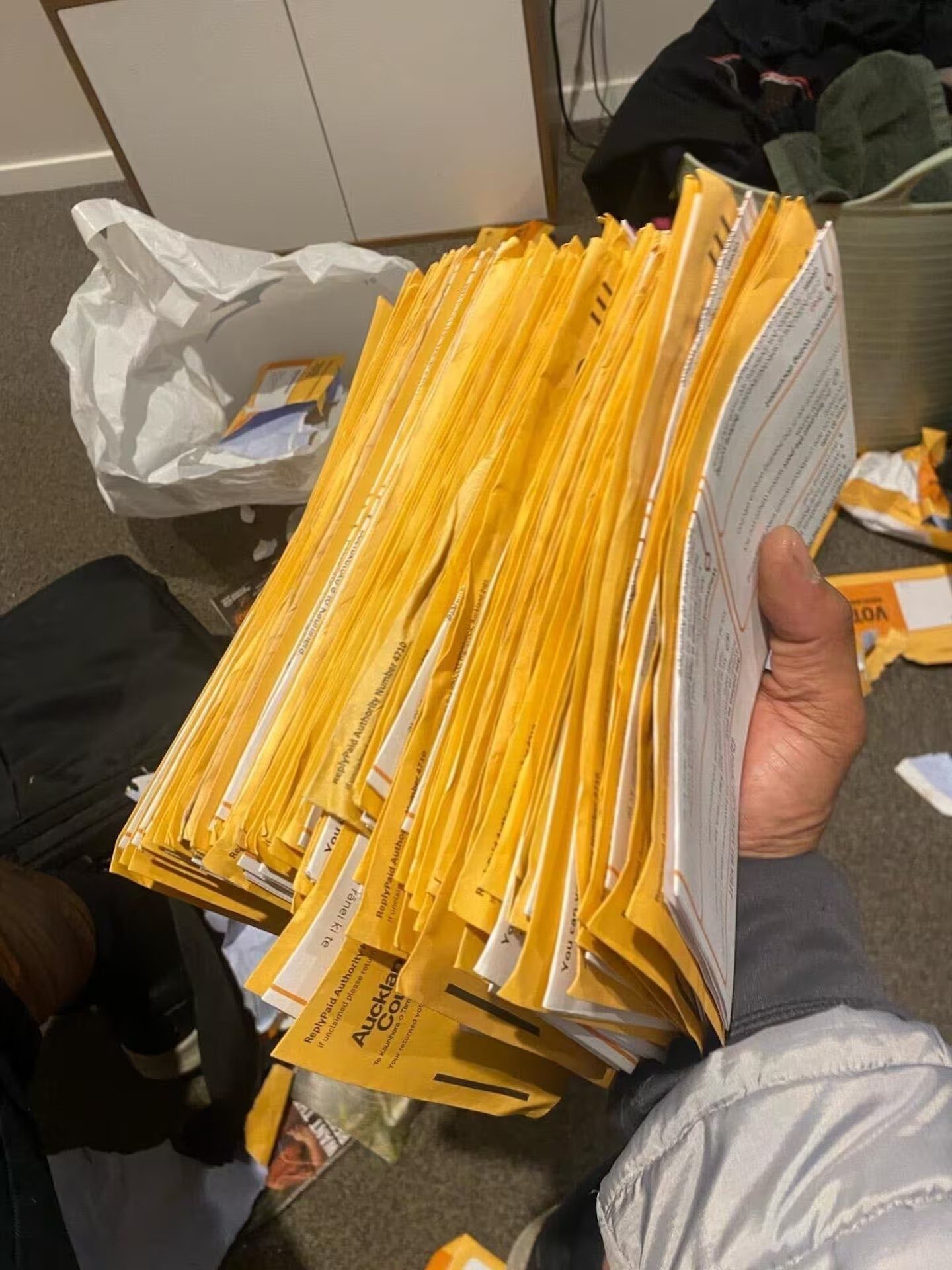
In August a whistleblower handed over photographs said to show bundles of voting papers taken from letterboxes during the 2025 Manurewa Local Board election.
It is alleged the papers were carried to an office, opened, filled in, resealed and posted back. None of it has been proven.
Election Services, the private company that runs Auckland’s elections, passed the matter to Police. The council also contacted the Serious Fraud Office, which would not confirm or deny that it was investigating.
Manurewa Local Board member Joseph Allan had already tried to raise the alarm. He laid complaints with the electoral officer and Police after the 2025 election.
“There were indications of fraud, but it was not possible to obtain sufficient evidence to proceed with a prosecution,” he told the Howick & Eastern Post. “We saw that in Papatoetoe.”
He said the photographs in the news had since triggered new investigations in Manurewa.
Allan called the council’s vote “a win for democracy”.
“Booth voting provides a more secure system,” he said. “The postal system has had its day.”
He said people had asked him what the change would mean for disabled voters.
“There are systems in place under the general elections,” he said. “I believe it is important that Council offers the same or equivalent level of access to all.”
“$40 million over one person?”
The argument against booths has been about money.
In September staff costed a 10-day booth election at $31 million to $40 million, against about $16 million for another postal vote. The council’s long-term plan had $11.2 million set aside.
Mayor Wayne Brown moved the motion that brought the booths back, then voted against it. He told councillors there was “no evidence whatsoever” that booths were better, and called the cost “prohibitive and ridiculous”.

When Otara-Papatoetoe Local Board chair Apulu Reece Autagavaia addressed the meeting, Brown pointed out that the re-run had changed only one seat.
“$40 million over one person?” he said.
“We’re talking about possibly spending 2 per cent of our rates just to solve a couple of postal things.”
“Is that how much you value our democratic right to vote for our representatives?” Autagavaia said.
“The cost is the cost,” North Shore ward councillor Richard Hills said. “I don’t think it is cost of living versus democracy.”
The motion that passed capped spending at $20 million. Chief executive Phil Wilson would not promise it could be done.
“I cannot sit here and the staff cannot sit here and tell you we can do booth voting for $20 million,” he said.
Papers for this month’s workshop show $20 million would buy about 55 advance voting places and 170 on election day, enough for a turnout of about 21 per cent. About 29 per cent voted in 2025.
A $27.6 million option would provide about 100 advance places and 345 on the day, with room for a 40 per cent turnout.
Councillors will decide on 15 December how many voting places they are prepared to pay for, with the money to be found in the 2027-2037 long-term plan.
“There is no doubt that in-person voting will cost more than postal ballot voting,” Hausia said.
“However, the cost of losing the public’s trust in our democratic voting system is far greater, and that trust is much harder to repair.”

