


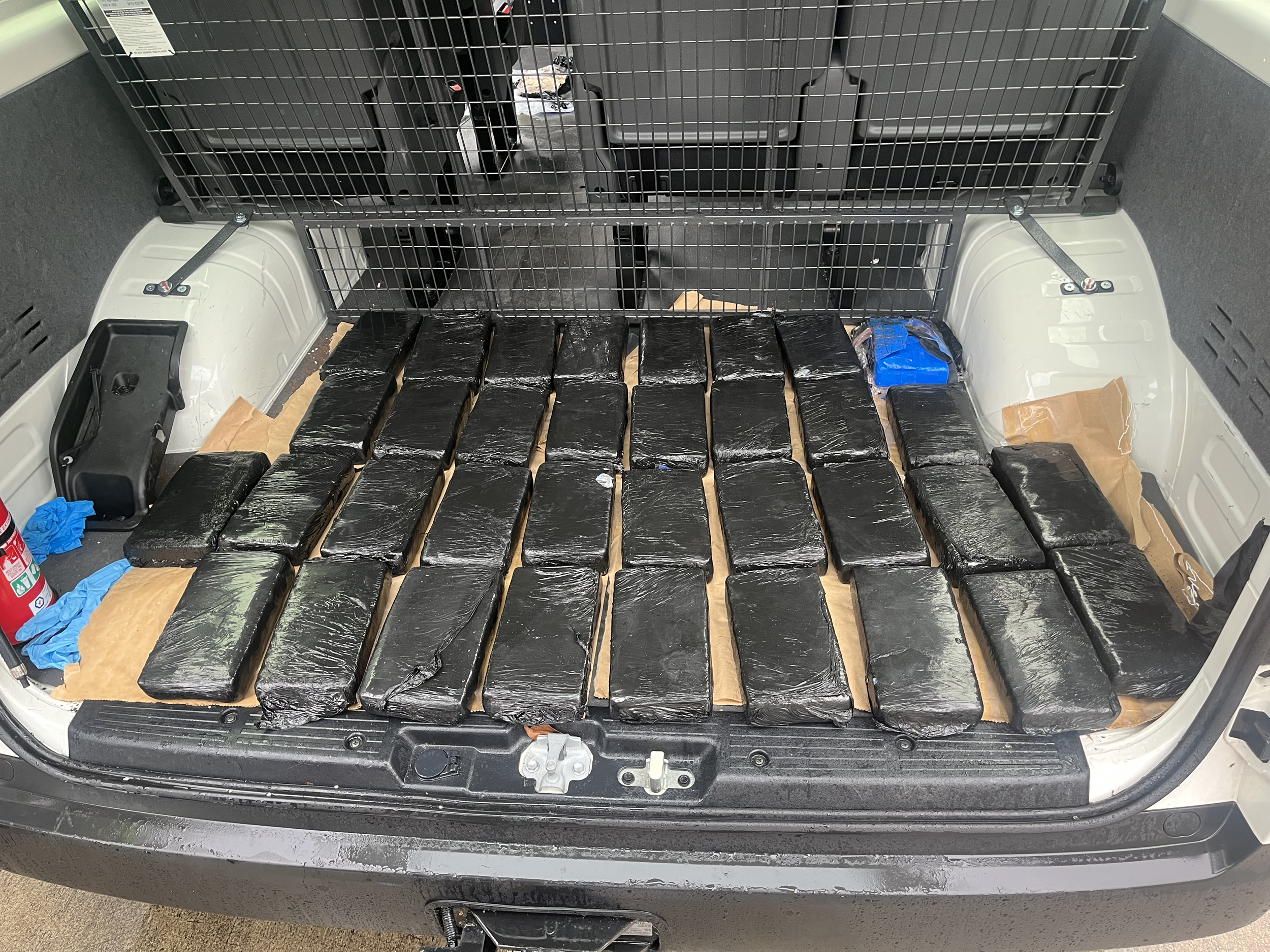
Workers unpacking a shipping container at a south Auckland business on Tuesday morning found bags that did not belong there.
Inside were 137 bricks of cocaine, 137 kilograms in all, with an estimated street value of $40 million.
Detective Inspector Karen Bright, of Counties Manukau CIB, said staff grew suspicious of the bags and called police, and officers found the bricks packed inside.
A further search turned up two Glock pistols, ammunition magazines and around 200 rounds of ammunition.
Police say the cocaine, about 1.37 million doses, came from the Netherlands by way of Balboa in Panama.
“This is a significant seizure of cocaine for this country,” Bright said.
She said police were working with international law enforcement partners and with Customs, and enquiries into the shipment were continuing.
Police have not named the business, and no arrests have been announced.
It is the second time in a year Auckland workers have stumbled on a fortune in cocaine while unloading ordinary stock.
Last November, staff at an Auckland business found 36kg in bags sitting on top of goods shipped from Brazil.
Detective Senior Sergeant Jason Hunt, of the National Organised Crime Group, called that find “a prime example of a ‘rip on’ or ‘rip off’ importation”.
He said it was a common method, with criminal groups using the genuine details of a legitimate company’s import to slip their drugs in among its goods.
Hunt credited the workers who raised the alarm.
“I acknowledge the staff for doing the right thing,” he said.
He said taking that much cocaine off the market may have spared the country up to $13 million in social harm.
The market that shipment was heading for has grown fast.
Police wastewater testing, covering almost 80 per cent of the population, put national cocaine use at half a kilogram a week in early 2022.
By the end of 2025 it was 9.4kg a week, more than MDMA for the first time, and it was still running at 6.8kg a week in the June quarter this year.
Detective Inspector Tim Chao, of the Police National Drug Intelligence Bureau, which runs the testing, said cocaine had long been seen as a drug for celebrities, lawyers and accountants, but growing supply had carried it across the social spectrum.
“It’s not just in our urban environments, but our rural environments,” he said.
When the figures first leapt in late 2024, Chao said police were troubled by them.
“These results are concerning, and work continues to try and understand the sudden increase,” he said.
He said police wanted people who use drugs to understand the violence and harm that goes into making and moving them, and that 20 government agencies were working to make New Zealand an unattractive place for organised crime to do business.
Massey University’s Drug Trends Survey of people who use drugs found the price of a gram fell from $368 in 2017/18 to $247 once inflation is counted.
Professor Chris Wilkins, who leads the survey, says cocaine here is in a “‘honeymoon’ phase where use looks glamorous and consequence-free”.
He says New Zealand largely escaped earlier cocaine booms, so people see the drug as low risk, unaware of the addiction, mental illness and heart problems it has left behind in North America and Europe.
“We’ve missed that cultural memory of large levels of cocaine use and harm,” he said.
Wilkins warned that cocaine was likely travelling routes Mexican cartels built for methamphetamine, the same channels that carried fentanyl-laced drugs into North America, and called for closer watch at the border.
Anyone with information about the south Auckland seizure can contact Police on 105 or Crime Stoppers anonymously on 0800 555 111.

